Unser bzw.
mein besonderer Wunsch war es immer eine Wiese zu haben. Und da im Frühjahr nach dem Gartenkauf die Primeln – die ‚echten Medizinalprimeln’
(österreichisch) bzw. primula veris bereits in der Wiese waren, war der
Grundstock gelegt. Sie haben sich in der Zwischenzeit noch weiter ausgesät. Dafür
hat der Wiesenmanager gesorgt. Nur die Margeriten sind etwas weniger geworden,
obwohl das Gras nicht liegen bleibt. Früher haben
die ‚Reiter’ das Gras gemäht. Die hatten
in der Nähe die Pferde stehen und waren froh, daß es Gras gab. Allerdings wurde
gemäht, wann die Pferde hungrig nach frischem Gras waren und nicht nach dem
Gesichtspunkt, wann bestimmte Blumensamen reif waren. Außerdem konnten ich
keine Narzissen in die Wiese setzen. Jetzt galoppieren die Pferde im Himmel und
wir haben das Problem mit dem Heu. Aber dafür können jetzt Narzissen und Co. in
die Wiese gesetzt werden und die Schachbrettblumen dürfen sich aussäen. Ich hatte da ein Bild im
Buch ‚Flora Britannica' gesehen, und bei Übernahme des ‚Gartens’ diese gleich
gepflanzt– wobei natürlich dann die ersten Blütenköpfe gefehlt haben (Mäuse,
Kaninchen, Hamster?). Jetzt fällt es nicht mehr so auf, wenn was fehlt. Mein
Mann hat das in die Hand genommen und statt 10 Zwiebeln – wie ich – gleich 100
gesetzt. Der Wiesenmanager sammelt immer Samen (von anderen Wiesen oder
aus den Beeten). Und dann muß ich natürlich alles bewundern, was in der Wiese wächst. Aber dadurch haben
wir Besuch von Schmetterlingen. Die kommen aber auch für das was in den
Beeten wächst, ebenso die Hummeln, Wildbienen, Honigbienen, Holzbienen und jede
Menge anderer Insekten. Holzbienen
haben sich angesiedelt, nachdem einige Sauerkirschen kaputt gingen. Zur Freude
des Spechtes, da die Larven wohl nach seinem Geschmack sind.
Holzbienen lieben übrigens Muskatellersalbei und ausdauernde Wicken.
We respectively I especially wished to
have a meadow. Because in spring – after we bought the garden – the prime roses
(the true ‘Medicinal prime rose (like we in Austria
say) or primula veris - have been in the meadow – the basis was already there.
In the meantime they have self-seeded. For that the meadow-manager cared. Only
the ox-eye daisies are disappearing, though the grass is removed after one
day. In the first years the ‘riders’ have cut the
grass. They had horses nearby and were quite happy, there was grass. But they
cut it, when the horses were hungry for fresh green and not from the point of
view, when seeds of special flowers were ripe. Also I could not plant narcissus
in the meadow. Now the horses career in heaven and we have the problem with the
lot of hay. But now I can plant narcissus and co. in the meadow
and the snake’s head is allowed to self-seed. I saw a photo in
‚Flora Britannica’ and after we got the garden, I planted the bulbs – whereas
in the beginning the flower buds were eaten (mice, rabbits, hamster). In the
meantime it is not so obvious, when flower buds are missing. My husband planted
100 bulbs, whereas I planted only 10. The meadow-manger always collects seed
from other meadows or from the borders. And I have to admire everything. But this is the reason, why butterflies are visiting us. But they also visit the borders as well - the
bumblebees, the wild bees, the honey bees, the carpenter bees and a lot of
other insects. The carpenter bees have located themselves, after some sour cherry trees broke down - for the
delight of the woodpeckers. They like the larvae. By the way carpenter bees love clary and
everlasting peas.
Fotos: mein Mann - photos made from my husband
Meleagriswiese - meadow with meleagris
C-Falter - comma butterfly
Schachbrett - marbled white
 Tagpfauenauge - peackock
Admiral - admiral
 unbekannter Falter –
unknown butterfly
unbekannter Falter –
unknown butterfly
 Distelfalter - painted lady
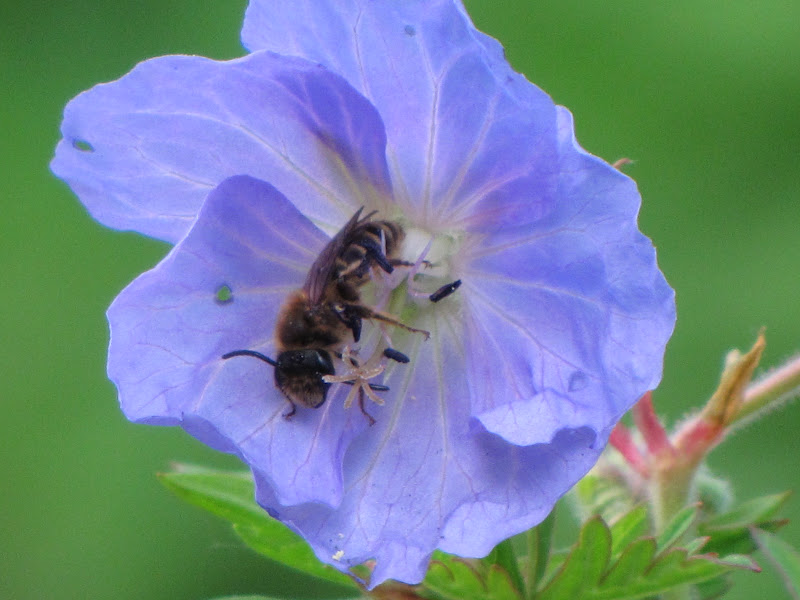
 schlafende Wildbiene – sleeping wild bee
Holzbiene – carpenter bee
 Aurorafalter
– orange tip
Aurorafalter
– orange tip
Holzbiene – carpenter bee